
DCR vs. Non-DCR Solar Panels in India: Policy, Costs, and the Supply Dilemma
A comprehensive guide to Domestic Content Requirement (DCR) vs. Non-DCR solar panels in India—explaining policy mandates, pricing premiums, supply bottlenecks, and what developers and homeowners need to know.
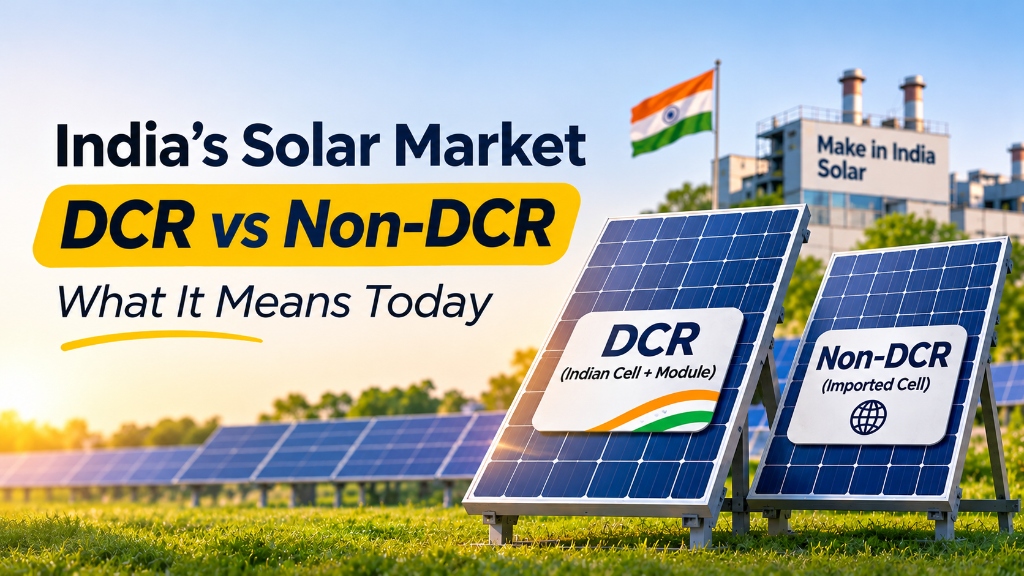
The Great Solar Debate in India: DCR vs. Non-DCR
As India accelerates toward its ambitious target of 500 GW of non-fossil energy capacity by 2030, the domestic solar sector is undergoing profound structural shifts. Among the most widely debated technical and regulatory topics in today's renewable market is the distinction between DCR (Domestic Content Requirement) and Non-DCR solar panels.
Whether you are a residential homeowner evaluating rooftop solar under government schemes, an EPC contractor, or an industrial power consumer, understanding the implications of DCR regulations is essential for making informed technical and financial decisions.
1. What are DCR Solar Panels?
DCR stands for Domestic Content Requirement. Under guidelines framed by the Ministry of New and Renewable Energy (MNRE), a solar photovoltaic (PV) module is classified as DCR-compliant only if both the solar cells and the solar modules are manufactured within India.
Key criteria of DCR modules include:
- Locally Fabricated Solar Cells: The silicon wafer is processed into a functional photovoltaic cell inside an Indian manufacturing facility.
- Locally Assembled Modules: The cells are interconnected, laminated with EVA and backsheet/glass, framed, and junction-boxed in an Indian module plant.
- Strict Verification: Manufacturers must provide verifiable serial numbers and traceability certificates confirming that imported cells were not substituted during assembly.
2. What are Non-DCR Solar Panels?
Non-DCR solar modules refer to photovoltaic panels where either:
- Modules are assembled in India using imported solar cells (primarily sourced from Tier-1 manufacturers in China or Southeast Asia).
- Fully assembled modules are imported from overseas (provided they are enlisted in the government's Approved List of Models and Manufacturers, or ALMM).
Because the upstream silicon cell manufacturing ecosystem in India has historically been limited, Non-DCR modules have long formed the bulk of solar installations across commercial, industrial, and utility-scale solar farms.
3. Key Differences Between DCR and Non-DCR Panels
| Feature | DCR Solar Panels | Non-DCR Solar Panels | | :--- | :--- | :--- | | Cell Origin | Manufactured in India | Imported (typically China, Vietnam, Malaysia) | | Module Origin | Manufactured / Assembled in India | Assembled in India or imported | | Pricing | Higher (typically 15% – 30% premium) | Cost-competitive | | Government Subsidy | Eligible for PM Surya Ghar, KUSUM, CPSU | Ineligible for central capital subsidies | | Technology Options | Rapidly expanding Mono PERC & TOPCon | Widest range (N-Type TOPCon, HJT, Bifacial) | | Primary Target Market | Residential rooftop, government tenders | Commercial, Industrial, Utility-scale Open Access |
4. Why Does DCR Matter? Government Mandates & Subsidies
The Indian government instituted DCR policies under the vision of Aatmanirbhar Bharat (self-reliant India) to protect domestic manufacturers from aggressive foreign pricing and to build end-to-end solar supply chain security.
Where DCR is Strictly Mandatory:
- PM Surya Ghar: Muft Bijli Yojana (Residential Rooftop Solar): To claim Central Financial Assistance (CFA) or direct subsidy payments, residential solar systems must use MNRE-certified DCR panels.
- PM-KUSUM Scheme: Solar water pumping and decentralized rural solar plants funded by government capital require domestic cells and modules.
- CPSU Tenders (Phase-II): Public sector utilities (such as NTPC, SECI, and state discoms) developing solar farms with government viability gap funding must procure DCR modules.
Where Non-DCR is Permitted:
- Commercial & Industrial (C&I) Rooftops: Factories, warehouses, and institutions investing their own capital without central subsidies can freely utilize high-efficiency Non-DCR modules.
- Private Independent Power Producers (IPPs) & Open Access: Large-scale open access and group captive installations are not bound by DCR rules, though they must adhere to the ALMM mandate.
5. The Core Issue: The Supply Chain Bottleneck
While the intent behind DCR policy is strategic and commendable, the ground reality has created notable friction in the Indian solar market:
- Cell Manufacturing Deficit: While India's module assembly capacity has crossed 60 GW, domestic cell manufacturing capacity remains significantly smaller (around 10–15 GW). This severe upstream deficit creates acute shortages of DCR-grade modules whenever flagship schemes like PM Surya Ghar trigger surge demand.
- The Price Premium vs. Subsidy Benefit: DCR panels typically cost ₹5 to ₹8 per watt-peak more than Non-DCR equivalents. For small residential rooftop installations, a substantial portion of the government subsidy is effectively absorbed by the higher purchase price of DCR hardware.
- Technology Lag & Upgrades: Global Tier-1 manufacturers transitioned rapidly to N-Type TOPCon cells offering higher efficiency (over 22%) and lower temperature coefficients. While leading Indian manufacturers are commissioning state-of-the-art TOPCon lines, the initial supply of DCR TOPCon modules has faced delivery backlogs compared to readily available Non-DCR stock.
6. The Road Ahead: Bridging the Gap
To resolve this imbalance, India has deployed strategic policy levers:
- Production Linked Incentive (PLI) Scheme: The central government has allocated over ₹24,000 crore under Tranche I & II of the Solar PLI scheme to establish fully integrated manufacturing—spanning polysilicon, ingots, wafers, cells, and modules.
- ALMM Re-imposition: Ensuring quality standards while curbing unfair dumping of substandard panels.
- Customs Tariffs (BCD): A 40% Basic Customs Duty on modules and 25% on cells incentivizes global players to invest directly in Indian production lines.
As domestic gigafactories for silicon ingots and solar cells become fully operational over 2025–2027, the price differential between DCR and Non-DCR modules is projected to shrink significantly.
7. Strategic Advice for Solar Buyers
- For Residential Homeowners Seeking Subsidies: Ensure your EPC vendor provides verifiable DCR documentation (RFID tag inside the glass laminate and manufacturer test certificates). Without valid DCR proof, your national portal subsidy approval will be rejected.
- For Commercial & Industrial Clients: If you do not require government capital subsidies, high-wattage Non-DCR (ALMM-approved) modules or bifacial TOPCon panels often deliver the lowest Levelized Cost of Energy (LCOE) and the fastest return on investment.
At Siret Energy Engineering, our engineering team guides clients through technical selection, regulatory compliance, and grid integration to deliver reliable, long-term renewable power performance.
Work with SIRET
Planning a renewable energy project?
Talk to our team about solar, storage and grid integration for your home or business.